Ok - we all admit it- 20 years ago we all were together doing a post-graduate Masters degree in Public Health. We met for dinner the other night-unfortunately it was at short notice so some of the others who were also in the class could not get there. Morten was visiting from Norway to attend a conference and the 5 of us got together after the Graves lecture in the College of Physicians. We don't think we have changed a bit.......
Friday, May 25, 2007


Sunday, May 20, 2007
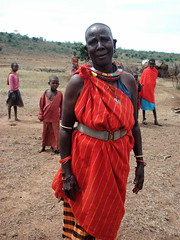
Lemoite
MIke Meegan, International director and founder of ICROSS says this about Lemoite:
The people with the best social skills do not even need to speak. One of my adopted sons in Africa is called Lemoite, ‘he who is everlasting’. Lemoite is a serene and gentle Samburu from the northern deserts of Kenya. He has always been a magnet for creation. Wild wart hogs played with him as a child, near his home he ran between the baby elephants and their mothers in Seketet, and angry guard dogs came to him like puppies, stilled by him. Birds and butterflies sat on his shoulder and Dikdiks and gazelles would come at his call. People are drawn to him in an unspoken relationship, effortless and innate. Perhaps it is a serenity that speaks to something inside us or a harmony as yet unstudied but I have few examples of such social power. Social intelligence is rooted in respect, self possession, delight in others and an insatiable appetite to embrace the stranger. There are in fact no strangers, only people waiting to be friends.

The people with the best social skills do not even need to speak. One of my adopted sons in Africa is called Lemoite, ‘he who is everlasting’. Lemoite is a serene and gentle Samburu from the northern deserts of Kenya. He has always been a magnet for creation. Wild wart hogs played with him as a child, near his home he ran between the baby elephants and their mothers in Seketet, and angry guard dogs came to him like puppies, stilled by him. Birds and butterflies sat on his shoulder and Dikdiks and gazelles would come at his call. People are drawn to him in an unspoken relationship, effortless and innate. Perhaps it is a serenity that speaks to something inside us or a harmony as yet unstudied but I have few examples of such social power. Social intelligence is rooted in respect, self possession, delight in others and an insatiable appetite to embrace the stranger. There are in fact no strangers, only people waiting to be friends.
Sunday, May 13, 2007
traditional birth attendant (TBA)
There is lack of consensus on the role of the TBA in
Kenya and other countries . There is evidence in the medical literature both from Kenya and other countries that training traditional birth attendants in hygeine and modern birth techniques may not always result in improved outcomes for mothers, while other literature shows that such training can in fact improve outcomes . It has been noted in reviews of maternal care in Kenya also that women continue to die in childbirth because they are not referred in time for obstetric care. However, in looking at some of the literature it is clear that such evaluations do not always in tur evaluate the quality of training offered to TBAs. It is also clear to me that in the rural areas of Kenya, where people live in a traditional manner and where lack of roads and infrastructure meant that travel is extremely difficult it may not be simply a failure of the TBAS to refer for care in time
There is also shortage of skilled midwives and doctors to provide care in the rural areas . No more than in developed countries qualified professional staff in Kenya in general choose to live and work in the larger urban centers- Sylvia- the nurse mentioned in a previous post is a exceptional person.
Kenya continues to provide training for TBAs, and this as part of the wider suite of interventions to address many of the other social and health issues is a positive approach.. As a recent report form kenya says : Evidence has shown
that where there is strong leadership, motivated or
supported health care providers, and strong
partnerships with TBAs, more women seek the
quality care services during pregnancy, childbirth
and postpartum period. The challenge is now to
utilise the TBA more effectively during a transition
strategy from TBAs to increased skilled attendance for all women at birth.http://www.popcouncil.org/pdfs/SafeMom_TBA.pdf.
Kenya and other countries . There is evidence in the medical literature both from Kenya and other countries that training traditional birth attendants in hygeine and modern birth techniques may not always result in improved outcomes for mothers, while other literature shows that such training can in fact improve outcomes . It has been noted in reviews of maternal care in Kenya also that women continue to die in childbirth because they are not referred in time for obstetric care. However, in looking at some of the literature it is clear that such evaluations do not always in tur evaluate the quality of training offered to TBAs. It is also clear to me that in the rural areas of Kenya, where people live in a traditional manner and where lack of roads and infrastructure meant that travel is extremely difficult it may not be simply a failure of the TBAS to refer for care in time
There is also shortage of skilled midwives and doctors to provide care in the rural areas . No more than in developed countries qualified professional staff in Kenya in general choose to live and work in the larger urban centers- Sylvia- the nurse mentioned in a previous post is a exceptional person.
Kenya continues to provide training for TBAs, and this as part of the wider suite of interventions to address many of the other social and health issues is a positive approach.. As a recent report form kenya says : Evidence has shown
that where there is strong leadership, motivated or
supported health care providers, and strong
partnerships with TBAs, more women seek the
quality care services during pregnancy, childbirth
and postpartum period. The challenge is now to
utilise the TBA more effectively during a transition
strategy from TBAs to increased skilled attendance for all women at birth.http://www.popcouncil.org/pdfs/SafeMom_TBA.pdf.
Friday, May 11, 2007
samburu mother and child
Kenyan Unicef statistics for 2005 :Under-five mortality rate - Probability of dying between birth and exactly five years of age expressed per 1,000 live births =120
Kenyan Infant mortality rate in 2005 - Probability of dying between birth and exactly one year of age expressed per 1,000 live births.= 79
In Ireland in 2005 the under 5 mortality rate was 6 and the infant mortality rate was 5.

Kenyan Infant mortality rate in 2005 - Probability of dying between birth and exactly one year of age expressed per 1,000 live births.= 79
In Ireland in 2005 the under 5 mortality rate was 6 and the infant mortality rate was 5.
Daily Nation article
NEWS
Teachers’ wage bill up by Sh2.5bn
Story by NATION Correspondents
Publication Date: 5/11/2007
The Government will spend an additional Sh2.5 billion on salaries for its workers this month.
This follows the new salary perks for teachers announced recently. The Teachers Service Commission (TSC) secretary, Mr Gabriel Lengoiboni, disclosed this in Samburu yesterday.
Speaking at the launch of the Samburu Teachers Sacco front office, Mr Lengoiboni also noted that the commission needed 50,000 teachers to stem the current shortage.
Noting that some 36,000 children of school going age were still out of school, he urged pastoralists to take advantage of the free primary education programme to educate their children.
The TSC secretary made the announcement as the Bungoma Kenya National Union of Teachers (Knut) branch demanded 3,000 more teachers for local schools.
Branch executive secretary, Mr Fred Sichangi, said the teachers were needed to cater for about 5,000 pupils who had relocated from schools in the clash-torn Mt Elgon District.
Urgently need
“We urgently need 2,500 additional teachers for primary schools and another 500 for secondary schools,” Mr Sichangi said.
Seven teachers and five pupils have been killed in the violence in Mt Elgon, prompting desertion of 26 out of the district’s 107 schools. More than 170 teachers also fled the area.
Mr Sichangi warned that teachers in Bungoma would down tools in support of their colleagues in Mt Elgon unless the authorities moved fast to restore peace to facilitate learning activities.
Teachers’ wage bill up by Sh2.5bn
Story by NATION Correspondents
Publication Date: 5/11/2007
The Government will spend an additional Sh2.5 billion on salaries for its workers this month.
This follows the new salary perks for teachers announced recently. The Teachers Service Commission (TSC) secretary, Mr Gabriel Lengoiboni, disclosed this in Samburu yesterday.
Speaking at the launch of the Samburu Teachers Sacco front office, Mr Lengoiboni also noted that the commission needed 50,000 teachers to stem the current shortage.
Noting that some 36,000 children of school going age were still out of school, he urged pastoralists to take advantage of the free primary education programme to educate their children.
The TSC secretary made the announcement as the Bungoma Kenya National Union of Teachers (Knut) branch demanded 3,000 more teachers for local schools.
Branch executive secretary, Mr Fred Sichangi, said the teachers were needed to cater for about 5,000 pupils who had relocated from schools in the clash-torn Mt Elgon District.
Urgently need
“We urgently need 2,500 additional teachers for primary schools and another 500 for secondary schools,” Mr Sichangi said.
Seven teachers and five pupils have been killed in the violence in Mt Elgon, prompting desertion of 26 out of the district’s 107 schools. More than 170 teachers also fled the area.
Mr Sichangi warned that teachers in Bungoma would down tools in support of their colleagues in Mt Elgon unless the authorities moved fast to restore peace to facilitate learning activities.
Thursday, May 10, 2007
A lesson from Kenya
I have not really commented on the current nurses' industrial dispute in the HSE - but there are interesting lessons to be learned from Kenya- yes it is a third world country in many ways , but I have seen real and increasingly successful attempts to provide primary health care, in a way that embraces sustainable community development. I met skilled health professionals who are living and working within their own communities, many with a commitment to developing quality services that is truly inspiring. One of the news soundbites tonight was that Ireland is like a third world country in terms of it's health services- I think that in fact we are not doing half as well as many third world countries who have realised that actually developing preventive and primary care services is the way to ensure that they get best value for their investment in health. We talk about reorienting the services to primary care but it seems that it is the hospitals that always get most attention. For many - both public and professional, plans for reorientation simply mean taking the interventions done in hospitals into the community instead of actually refocussing what we are delivering to address all of the determinants of health in a coherent and effective way.
www.healthintelligence.ie
www.healthintelligence.ie
studying for a scholarship
in 2003 the Kenyan government made primary education free for all children. Since then the rate of enrolment of children in primary school has increaed exponentially. However there remain regional disparities, and the large number of children who have enrolled has overwhelmed the system in many places. However ICROSS recognises that education is fundamental to improving health and reducing social inequalities, including gender inequalities. Therefore it has partnered with the government to help build schools in some of the most remote areas. T
However free primary schooling and a high enrolment rate is only the first part of the story- as well as the creaking system other issues mean that attendng school is difficult- As I have described simply finding water and food is a priority for many families-so actually getting to school is not the first thing they think of. As pastoralists the areas over which the familes may range is large and so children often must walk many kilometers to school- and as also one person told me - small children, while they might be able to walk long distances, are also in danger of being attacked by wild animals. Allied to this has been -in the Samburu area at least- a drought last year and intertribal raids which meant families moved out of the areas as refugees- and so again for many school was not a priority. Thankfully they are now moving back .
Teachers are paid by the government and are allocated to areas with little or no choice in that allocation - so they may be allocated to areas where they are not familiar with the local tribal language- I was told teaching is done through Swahili and English.
Girls are less likely to attend school than boys- Many of the practices that impact negatively on women can really only be addressed by education- Female genital mutilation, early marriages and general social deprivation all are best addressed by educating women to a level that allows then to become both questioning of the social norms and also independant and able to earn a living for themselves.
No more thanprovsion of free ARVS for HIV/AIDS but then charging for tests etc, free education does not extend to providing basic basic requirements such as copy books and pens- again ICROSS steps in to help by giving these discreetly to deprived families though the local community workers.
Providing very basic school buildings and pencils and paper may not have the immediacy of, for instance, caring directly for people with AIDS but as a way to improve the health of the population in a sustainable way and address gender inequalities this is the way to go. ~A challenge for ICROSS KENYA is to use it's assets well to address the many areas it needs to deal with-and to balance the application of it's help between good evidence base and sustainablity and immediate and high profile media- ( and donor) attractive interventions.

However free primary schooling and a high enrolment rate is only the first part of the story- as well as the creaking system other issues mean that attendng school is difficult- As I have described simply finding water and food is a priority for many families-so actually getting to school is not the first thing they think of. As pastoralists the areas over which the familes may range is large and so children often must walk many kilometers to school- and as also one person told me - small children, while they might be able to walk long distances, are also in danger of being attacked by wild animals. Allied to this has been -in the Samburu area at least- a drought last year and intertribal raids which meant families moved out of the areas as refugees- and so again for many school was not a priority. Thankfully they are now moving back .
Teachers are paid by the government and are allocated to areas with little or no choice in that allocation - so they may be allocated to areas where they are not familiar with the local tribal language- I was told teaching is done through Swahili and English.
Girls are less likely to attend school than boys- Many of the practices that impact negatively on women can really only be addressed by education- Female genital mutilation, early marriages and general social deprivation all are best addressed by educating women to a level that allows then to become both questioning of the social norms and also independant and able to earn a living for themselves.
No more thanprovsion of free ARVS for HIV/AIDS but then charging for tests etc, free education does not extend to providing basic basic requirements such as copy books and pens- again ICROSS steps in to help by giving these discreetly to deprived families though the local community workers.
Providing very basic school buildings and pencils and paper may not have the immediacy of, for instance, caring directly for people with AIDS but as a way to improve the health of the population in a sustainable way and address gender inequalities this is the way to go. ~A challenge for ICROSS KENYA is to use it's assets well to address the many areas it needs to deal with-and to balance the application of it's help between good evidence base and sustainablity and immediate and high profile media- ( and donor) attractive interventions.
Saturday, May 5, 2007
and when the boreholes work
So here is an example of a working borehole- These gorgeous women standing on each side of me were about to go to the market when we arrived to see the borehole- they are members of the key-holding family. The borehole itself is a center of activity- when we walked down to it there were some morans ( young warriors) there. Sorry no photographs as they actually had been washing , did not have all their jewellery ( or clothes) on and anyway were rather surprised to see a middle aged mzungu at their water hole. Many people in Kenya do not like to have their pictures taken and I made a point of not photographing anyone unless they were happy for me to do so.
So back to the water issue- if you look at the other pictures I have posted on Flickr you will see that around the well is green and fertile, and there is water available. As both humans and animals use this as a water source, one of the things that would improve the situiaton further is to build some facilities that separate the human and animal usage, as at present there is a possibility that the source itself can become contaminated by animal excrement. Also as I noted, it is being used for washing and so if a separate washing area was built with the run-off diverted away from the source it would also be an improvement. There are keyholders for the borehole and i was told that the water is locked to conserve it- however the cement lid over the source had been broken - clearly people were accessing the water through this when the pump was locked. But it was clear that the support given by ICROSS to provide the pump was very much appreciated, and has made a considerable difference to the people living nearby who now not only were following the traditional herder lifestyle but also were growing crops such as beans and maize

So back to the water issue- if you look at the other pictures I have posted on Flickr you will see that around the well is green and fertile, and there is water available. As both humans and animals use this as a water source, one of the things that would improve the situiaton further is to build some facilities that separate the human and animal usage, as at present there is a possibility that the source itself can become contaminated by animal excrement. Also as I noted, it is being used for washing and so if a separate washing area was built with the run-off diverted away from the source it would also be an improvement. There are keyholders for the borehole and i was told that the water is locked to conserve it- however the cement lid over the source had been broken - clearly people were accessing the water through this when the pump was locked. But it was clear that the support given by ICROSS to provide the pump was very much appreciated, and has made a considerable difference to the people living nearby who now not only were following the traditional herder lifestyle but also were growing crops such as beans and maize
Thursday, May 3, 2007
the patriarch- Nataka Maji
Nataka maji- I need water.
Water is a basic necessity of life. However in the Samburu area the water sources are often unreliable. The area recently suffered a major drought from which it is slowly recovering. Added to that is the distance and infrastrucutural issues I have mentioned before.
We visited a number of water projects that had been funded by ICROSS. These pictures are about a borehole that had been dug about 2 years ago. But for the last 3 months the pump has been broken. There had been some difficulty finding a new pump part and in consequence the community in the area have to travel up to 10 kilometres to another water source. I can understand how mistakes cam be made in accessing suitable spare parts, but relying on Ministry of Health - try as it does - or the local community to maintain the water supplies and schools and other community supports that have been seed funded by NGOs may be premature. I absolutely understand the need to ensure that communities become self sustaining , but I question how quickly this can be expected to happen. The other question is in terms of immediate public health, and if a more medium term commitment to maintenance while lobbying for and developing other area of infrastructure would be a more effective longterm strategy? I don't know the answer at present- but I do know that the people I saw here were struggling to cope and were clear that a priority for them was restoring the water pump as soon as possible. AS for the other issues- NGOs such as ICROSS are just part of the picture- but perhaps we need to support them more explicitly to sustain the projects they help to start

Water is a basic necessity of life. However in the Samburu area the water sources are often unreliable. The area recently suffered a major drought from which it is slowly recovering. Added to that is the distance and infrastrucutural issues I have mentioned before.
We visited a number of water projects that had been funded by ICROSS. These pictures are about a borehole that had been dug about 2 years ago. But for the last 3 months the pump has been broken. There had been some difficulty finding a new pump part and in consequence the community in the area have to travel up to 10 kilometres to another water source. I can understand how mistakes cam be made in accessing suitable spare parts, but relying on Ministry of Health - try as it does - or the local community to maintain the water supplies and schools and other community supports that have been seed funded by NGOs may be premature. I absolutely understand the need to ensure that communities become self sustaining , but I question how quickly this can be expected to happen. The other question is in terms of immediate public health, and if a more medium term commitment to maintenance while lobbying for and developing other area of infrastructure would be a more effective longterm strategy? I don't know the answer at present- but I do know that the people I saw here were struggling to cope and were clear that a priority for them was restoring the water pump as soon as possible. AS for the other issues- NGOs such as ICROSS are just part of the picture- but perhaps we need to support them more explicitly to sustain the projects they help to start
Subscribe to:
Comments (Atom)


